Monday, March 30, 2015

Livestock Production


Sorry this post is a few weeks in the making - we just got back from our second field trip, this time to the Atlantic coast of Costa Rica and even into Panama. I'll hopefully be posting about it soon!

So the Wednesday before we left for the field trip was our last Humans in the Tropics lecture / field trip for our time in Monteverde. We spent it learning about livestock and meat consumption. We learned about the history of livestock here in Monteverde and its impact on the people and the economy. In the northern province of Guanacaste, land was primarily converted from rainforest to agricultural and grazing lands for cattle. In other parts of Central and South America, rainforest was also being drastically transformed into land for cattle. Why? Our fetish with hamburgers. In 1995, Brazil exported over $500 million worth of beef. In 2003? $1.5 billion. Our desire to consume beef has been exponentially growing in the past few decades, with no sign of slowing down. With this increase in beef consumption comes a drastic increase in deforestation of tropical rainforest in Central and South America.

Some surprising numbers I learned from lecture that day:

- Of the 7 billion people living on Earth, 2/3 are vegetarian.

- That only 1/3 of the human population have diets primarily focused on meat. The majority of this population lives in developed nations. As more and more countries become developed, that 1/3 could easily turn into 2/3, or higher. This increase in demand must mean an increase in supply. How do we increase supply? By cutting down rainforest to make land for livestock.

Some other startling information we learned was the health of livestock. In the United States, 70% of antibiotics used each year are given to livestock.

Yes, you read that right. Livestock are getting the majority of produced antibiotics made in our country every year. They are used to treat diseases, which really is extremely important and should be continued. The prevention of disease is just as important, though I would argue that the amount used for this purpose could be greatly reduced. The worst use of antibiotics is for growth promotion. Many medications are given to livestock and poultry simply to increase their size and shape, which would increase the meat from each animal in a quicker period of time.

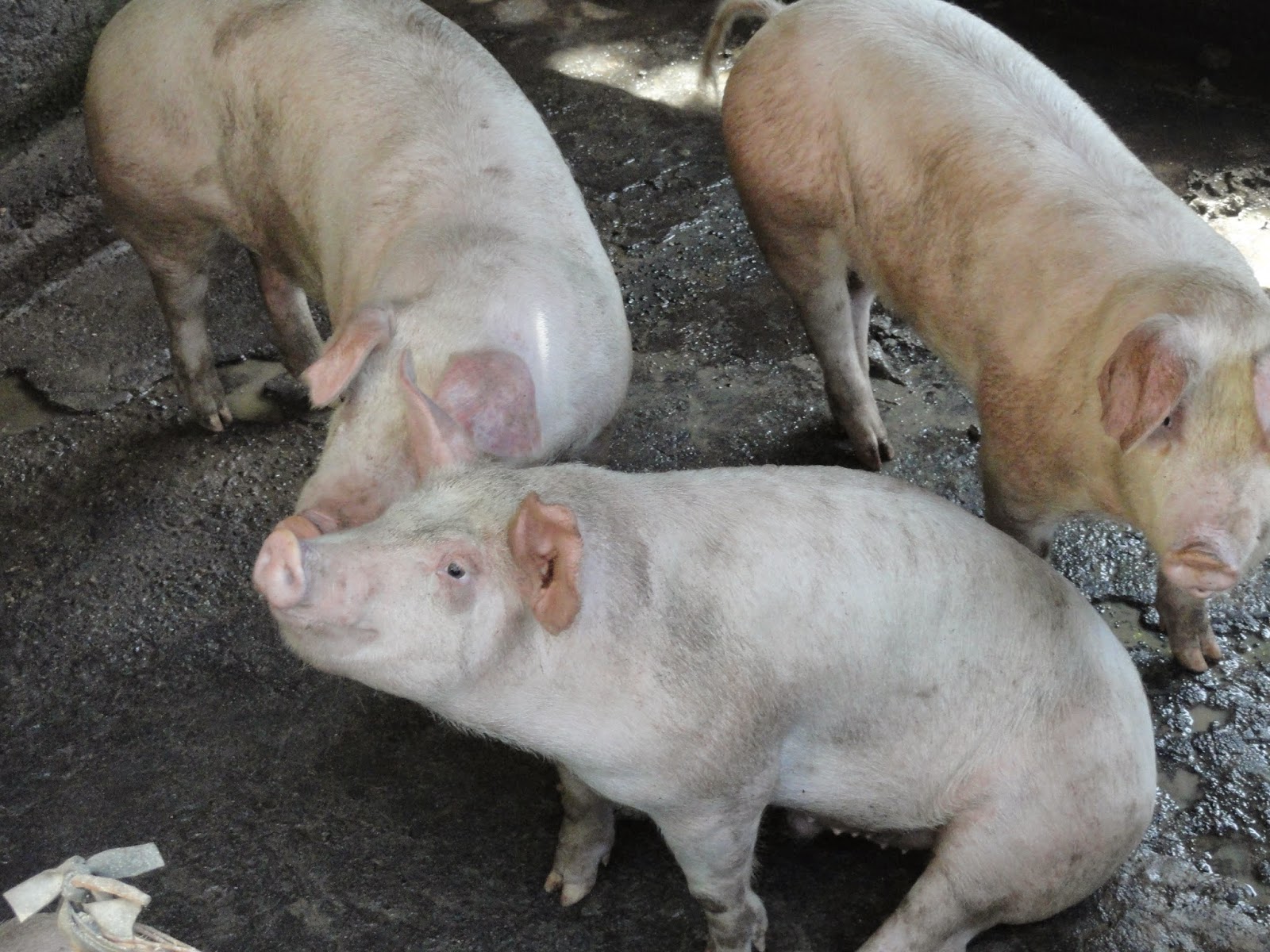
Anyway, we traveled to two farms that day. The first was owned by an elderly man named Don Jesus. Don Jesus owns and runs a small-scale dairy farm here in Monteverde. He primarily uses the milk to make cheese or to directly sell to consumers at local markets. He owns 11 cows, 8 of which give milk. He also raises pigs as a way of making some electricity and getting rid of some food scraps (I'll explain more about the electricity part later).

Three pigs that Don Jesus has raised.
Chickens on Don Jesus's farm
Don Jesus owns and runs the farm on his own, with some help from his adorable wife.

I was asking Don Jesus's wife about her chickens.
Also, photo courtesy of Dan L.
He does all of the milking for each of the 8 cows twice a day. He allowed us to help him with the milking (we did it by hand, he actually uses a machine). It was rather fun to learn how to milk a cow  - I was pretty good at it too! He had a calf tied up nearby, who I played with while everyone else was taking turns milking the cows.

He really loved getting his face scratched. 
He even smiled. 
Don Jesus also showed us his biodigester, which is a system that converts pig manure into usable energy. I won't get into the nitty-gritty science, but it's basically a long tube that holds the pig (or other animal's) manure and turns it into methane gas, which can be used to power whatever the farmer needs on the farm or his house. 

We stayed for lunch at this farm and left after a few hours to go look at another farm, one that is not nearly as environmentally friendly as that of Don Jesus's, and was also one not nearly as conscious towards animal welfare. It was a pig farm owned by a man who runs a butcher shop. He controls every part of the business, including the breeding of the pigs, the raising of piglets, and the slaughtering of the animals for his butcher shop. I have no pictures to share, as this particular farm made me sick to my stomach. I was able to stay behind with the man's horse instead of getting a full tour of his property, who was tied up to a fence post. It helped and he was really sweet. I brought him some grass from a nearby field, and that made him perk up. There was also a dog tied up nearby, and I gave her all of my water. 


It was just a horrible place, I can't even describe the noises of the pigs. I think what hit me the hardest about that day was how poor the living conditions were for the animals: pigs, horse, and dogs. The pigs were stuffed in pens, sometimes 6 or more in a space less than the square footage of your small bathroom. Nails sticking out, no room to roam, nowhere separate to go to the bathroom. The horse was tied up so tightly to a post, out in the boiling sun, with no water. He had so many ticks and was really thin. I found out later that this man bought the horse from a neighbor to use as meat for his butcher shop, which didn't help my impression of him at all.

Friday, March 6, 2015

Coffee Farming and Monocrops


So Wednesday (February 25th) was Humans in the Tropics day. We had a brief lecture at 8am on coffee production (and some other major crops also). After the brief lecture, we packed into 3 buses and went for a little field trip across town. It was such a great field trip - we went to a local coffee farm that is 100% organic, all-natural, and pesticide free. The place is owned and run by a really cute woman. Her name is Hermida, and she was definitely the cutest woman ever. She does everything herself with the help of one full-time employee and a few of her sons.

All-natural, organic, pesticide-free coffee farm
She's had the farm for nearly 30 years now, and it sits on a 2 Ha plot of land, along with 4 Ha her son owns next door. She has two rivers that run through the farm, and she has kept the forests intact around the rivers to preserve the watershed. Not only does she plant coffee, but also medicinal plants, some used for bug repellent, others to prevent erosion and for making her own pesticides and fertilizers. Many of her practices are traditional, one of which is using the moon when planting. She plants during the waning moon (gets better results), plants grow faster in crescent moons, etc. It was really interesting to see how every little thing she does on that farm has a purpose.

She grows bananas because she uses the massive banana leaves to shield her young coffee plants from the sun. In modern coffee farms, they use plastic bags filled with chemicals to achieve the same thing. Hermida then uses the leaves as a part of her all-natural fertilizer. 
We spent most of the morning walking through her gardens, learning about all of the plants she grows and what she uses them for. She was really a prime example of how sustainable farming is possible, and it can be very beneficial for not only the farmer and the consumer, but for the environment. We also talked about how Doña Hermida does not associate with a co-op. This allows her to sell her products directly to consumers, so she has taken out the middleman in coffee production and is able to make a larger profit.

Coffee beans still on the plant. The redder the beans, the higher-quality the coffee.
Towards the end of the morning, she brought us to her drying house, where she keeps all of her coffee beans drying in the sun. There were so many types of coffee, and if I had any knowledge of coffee-lingo I would tell you what they were...

The greenhouse where she keeps all of her drying coffee beans

We stayed at her farm for lunch, which consisted of primarily fruits and vegetables grown in her garden. It was absolutely delicious! After lunch, she let us help her hand-grind coffee beans to make hot coffee, which was really fun! 

You put the coffee beans into the hole at the top and grind it into ground coffee
After we took turns grinding up the coffee beans, she brought out her coffee maker and a pot of hot water. We could finally see this whole process coming full-circle, from the coffee plant to the de-shelling process to drying the beans to grinding them into a powder and finally making coffee. It was such a long process, and it's incredible that she does this whole thing by herself.

The best kind of coffee maker (and environmentally friendly too!) You pour the coffee powder into the bag at the top and just add hot water! 
Learning about coffee production was definitely an eye-opening experience. We had a few lectures on sustainable farming and the effects of monocropping on the environment. So unfortunately, the rest of this post isn't quite as positive as the first, but I think it's really important for people to know about because this type of farming is what we're supporting when we buy fruits and vegetables from the supermarkets in the U.S. I'm going to talk about not just coffee, but some other major monocrops that are produced not just here in Costa Rica, but in other parts of Central and South America as well as in Africa.

Coffee

Coffee is very important to the Costa Rican economy. It encouraged the creation of a strong middle class, and in the early stages of coffee here, the government gave away land and coffee plants to people, then bought the coffee off of those farmers for export (basically, there was no way you could lose, unless you really sucked at farming). This caused a huge influx of immigrants from Europe who wanted a part of this fantastic deal. Here in Costa Rica, farmers focused on high quality over high quantity coffee. Now, there are 7.9 million tons of coffee produced annually, but that doesn't even compare to the coffee productions of Brazil, Vietnam, and Colombia. All of the processing of coffee is done in the country of origin, and each phase of production has different impacts on the environment. 

So now a little bit about the coffee plant... Coffee is actually an understory plant. It originally grew in rainforests and was shaded by the numerous layers of canopy above. But in terms of growing coffee for production, plantations don't always for the most environmentally friendly option, as shown below: 

http://www.coffeehabitat.com/wp-content/uploads/2006/02/shadelayers1.jpg
"Rustic growth" is not super common anymore, but essentially it is when coffee is still being grown in the rainforest, with numerous layers of canopy above it. "Traditional polyculture" reduces the amount of canopy, and so on until you get to "shade monoculture" and "Sun coffee." These last two are the most commonly used today. Sun coffee is probably the worst, as (1) the coffee is not being shaded and has a higher risk of being affected by a fungus that can ruin an entire crop of coffee and (2) this also contributes the most to erosion, as there are no other plants around with larger roots to hold the soil together, or even to just add nutrients. "Shade monoculture" is a close second to sun coffee. This is slightly better, as there are trees planted between the rows of coffee, which not only adds nutrients to the soil, but can also help prevent erosion. 

There are numerous negative environmental impacts of coffee, including deforestation, sedimentation, erosion, and run-off of pesticides into local waterways. In large coffee plantations, there are numerous chemical inputs which contribute to the run-off. There are huge amounts of biodiversity loss, which for a tropical environment with a lot of biodiversity, it can be devastating. Unfortunately, this is also an unstable business. Coffee is a seasonal crop, so there are many social problems associated with coffee plantations (people are often out of work for months at a time). 

And that was just coffee. 

Bananas

The story of bananas is a little different from that of coffee. Once upon a time, there was a United States-based company called United Fruit (currently known as Chiquita). They came into many Central American countries and basically took over the banana industry. At first it was very helpful. Because bananas were grown in the middle of Costa Rica, they put in a lot of time and money into building railroads and roads for transportation. Many think that without United Fruit, railroads may not have made it to the country for a very long time because of the high cost. This company had a lot of power in the government, as they controlled much of the economy of not just Costa Rica, but Guatemala, Nicaragua, and numerous other countries. They bribed the government and were able to bend rules to benefit their company. Today, this giant company isn't in control anymore, but Chiquita and 4 major banana companies are, and they still have a lot of influence. These companies control the prices, they control the trade, and many don't respect labor codes or workers' rights. 

So besides all of those social and economic impacts of bananas, there are numerous environmental impacts. Deforestation is a major one, along with land transformation to grow these huge banana plantations. Banana plants are pretty tall, and require a lot of upkeep. Something not many people know is that these plants only produce one bunch of bananas per plant. So after each bunch is produced, a whole plant is cut down and a new one is planted. The rest of the banana plant is waste, typically not used for livestock feed or anything, which is such a waste. There are also huge chemical inputs. They are picked green, shipped, and then when they are ready to sell, and ethylene gas is sprayed until the bananas turn yellow. Soil erosion, chemical runoff, and waste are other major environmental impacts of bananas. 

Fair-Trade

When you go to the grocery store, how often to you buy Fair Trade products, such as coffee? If and when you do, its to support the local farmers who are growing that product and directly selling to Fair Trade. The purpose of Fair Trade is to ameliorate price swings for the producer. If there is a low year for sales, the producer is guaranteed a price no matter what the sales are. It offers growers a fair price, which is the gist of Fair Trade. They are given decent labor agreements and are usually offered community and business development, such as the building of schools and scholarships for the children of farmers to go to college. Fair Trade eliminates the middleman. The growers trust the corporations to assure fair wages. In terms of what the consumer is getting out of this deal: we feel genuinely good about buying Fiar Trade coffee because we're doing good for the grower. But are we really?

There are thousands of farmers worldwide (mostly Central / South America and Africa). All of them get an "equal" share of sales profits at the end of the year. But when this is spread out over the thousands of farmers, their families, and employees, this turns into an extra $0.18 per person per day worldwide. In some places, this is a lot. But how is this helping these people? Is this even a viable option for these farmers? I don't know. They should be getting more, but how? It's all based on sales, so do we all need to up the amount of Fair Trade coffee we buy? 

So where do we go from here?

There is no easy answer to this question... We debated this for a long time, easily over an hour. These were some of the ideas that we were collectively able to agree upon: 

- There should be a fee on products that are not organic, all-natural. We should "punish," in a sense, those who do not buy organic, and that "punishment" should be paying extra for all of the chemicals they are purchasing along with the product. Reward those who buy organic with low prices, not the other way around. 
- Developed nations consume too much. We often forget that we don't actually need coffee to survive. But cutting down our consumption, we can collectively reduce the negative environmental impacts these huge plantations have. Cut back one cup a day. Or buy coffee brands that have certifications. There are dozens out there, including workers rights, less environmental impacts, all-natural, organic, etc. Buy coffee that tells you exactly where your coffee is from, who the farmer is. You'll feel better and will be doing better, too. 

The biggest message I got from that day was to just think more about where our food comes from. We have become so disconnected from the production of our food, so we don't think about the process. So think about the process, do your research, and buy smarter. 
Monday, March 2, 2015

Estación Biológica, Monteverde

This post is a week in the making, but we finally made it to Monteverde Biological Station! This place will be our home until mid-March, which means lots of lectures, Spanish classes, nature hikes, downtown adventures and much more!
So that first day we arrived (I want to say Saturday?) we just got settled into our rooms and had a small orientation lecture before dinner. The station is super nice, and it has that homey feel to it along with being a great place to learn and study.

Biological Research Station - Monteverde, Costa Rica
The classroom in the station, where we do all lectures and is a great place to study.
It's been about a week since we arrived, and we've already done so much! That Monday after we arrived, we went for an orientation hike through the forest on the mountain behind the station. It was such an awesome hike - basically this meant decreasing levels of oxygen paralleled with increasing amounts of mud. But nonetheless, it was an amazing hike. Our goal was to hike through some of the trails, reach the top of the mountain, and do some species reports at the top...

The road less traveled..?
All of the mud


That afternoon we walked to our Spanish class, which will take place at the Spanish Immersion School in Monteverde. We have class Monday, Tuesday and Thursday from 2:30 - 6:00 pm and Fridays from 2:30 - 5:00 pm (so much Spanish). Oh, also, this is what the place looks like: 

Spanish Immersion School (CPI) 
It has a hot tub, ping pong tables, workout room, yoga, cooking classes, and so much more. Its basically like going to Spanish class in a resort and spa. Anyway, the first day of class was spent taking a placement exam (written and oral), and playing some games with the professors. In total, there are 5 classes, each with no more than five students. My class has four, which is so nice. We get to talk a lot with the professor which helps improve conversational skills. I definitely wish we had classes this small back home, I would learn so much more. 

After Spanish class, we came back home (we get the option of taking a personal bus, as the walk back to the station is up a very big hill and it's dark) and had dinner. Every day after dinner is free-time, which most of this past week was spent studying the plant and animal species for the big exam on Saturday.

Tuesday was the first "official' start of classes at the station, which meant Tropical Community Ecology with Alan at 8:00 and Tropical Diversity at 11:00. Tuesday we spent in lecture for maybe an hour, and then went outside and did a lab. This lab entailed separating into groups of 2-3 and going into the woods and identifying different species of vines that can be found on the trees. After we could identify them, we were to choose 2 species from two different families, take a sample of 30 trees, and determine whether those 30 trees had one species or the other, both, or neither. Once we got back to the classroom, we performed a Chi-Squared test to compare expected values with our observed values. It was a cool little activity, and it allowed us to practice our statistics, too. 

After the activity, we went straight into Tropical Diversity at 11 until lunch. After lunch, we had a small break until Spanish class at 2:30. I learned more in that Spanish class than I did all last semester at school. Even though we were only reviewing preterite and imperfect verb tenses, it was just so much better because the professor was so much more engaging. We sang songs, talked about random things in Spanish, and just had a good time doing it. This is such an engaging Spanish class, and I'm so happy that it's an immersion school! 

After Spanish class, we got back to the station and had dinner and then most of us spent that night studying for the exam again. 

Wednesday was Humans in the Tropics day, but I'm going to talk about this in a separate post (so stay tuned)! 

Thursday was basically the same as Tuesday - we had Tropical Community Ecology in the morning at 8, but this time we learned about weather systems and how the rotation of Earth around the sun, along with its tilt, affect the weather in tropical habitats across the globe. We did a bit of a simpler lab - we separated into groups and used a globe, flashlight, and laser pointer to figure out how the seasons and all that works more in-depth. It was really interesting (and rather easy - thank you AP Environmental Science)! Tropical Diversity lecture followed at 11 again, but I can't remember what we talked about... 
At 2:30 we had Spanish again, which was just as awesome as Tuesday! We talked about prepositions a little bit, went over homework, and reviewed a little bit for the quiz on Friday. 

Friday - The schedule was a little backwards compared to Tuesday and Thursday. We had Tropical Diversity in the morning at 8:00, and promptly did a little lab outside at around 9:00. It was a really cool lab - in groups, we went out into either the forest or in the open area around the station and, from a sample of 20 trees, we recorded the number and types of lichen species found on each. It was a pretty cool little experiment, and it reminded me a lot of one I did in AP Environmental Science my senior year of high school, where in order to look at species diversity, richness, and evenness, we went out to the parking lots and counted the number of each make and model of car - they both essentially showed the same thing in terms of locations with more species richness and evenness.
We had Tropical Community Ecology after at 11, followed by lunch. Spanish was at 2:30 that afternoon as usual, and we had our first quiz of the class which luckily was super easy because I did minimal studying. Class only went until 5, which was awesome because that gave me more time that night to study for the Lab Practical exam Saturday. I spent all night studying, going over plant and animal species one last time...

Saturday - doomsday.

Just kidding it wasn't that bad. We had the lab practical exam at 9, which turned out to be slightly better than I anticipated. It was split into 3 parts: a table portion, a field portion, and a slide portion. The table portion consisted of tables covered in samples of plant and animal species (or stuffed animals). We had to answer questions about those species, which was probably the best way for me to take an exam. The field portion consisted of walking around the garden identifying species (by far the hardest portion of the exam. The slide portion was a slideshow of pictures and questions about species. I can't even explain how happy I was to finish that practical - definitely shed a few tears of joy :)

That night we "celebrated" by going into town to watch Alan's band perform at a local bar... they were pretty good :)

Saturday, February 28, 2015

Tico Culture - Slang

Slang is integrated into every language. Even within languages, there are terms that are only used in certain countries or even areas within countries. In the United States, we have our fair share of slang words - wicked is the most popular one that comes to mind, being from New England and even more so from Massachusetts. In the last 3 weeks of being in Costa Rica, I've been learning many slang words, so here is a compilation of my favorites:

Mae - buddy, dude

¡Ojalá! - if only...

Vieras - if only you could see it

Pura Vida - basically Hakuna Matata (can be used as a greeting or basically in any way you can think)

Chóquela / tome los cinco - Shake my hand

Estar en la luna - to daydream

Tuanis - very good / cool

¡Suave, suave! - wait

Grosero - rude

Tiqisa - country of the Ticos (Costa Rica)

¡Al Chile! - Seriously? (basically asking Are You Serious?)

Agüevado - how sad


Also, if anyone was dying to know the translation of John Lennon's Imagine, I learned it in my Spanish class the other day so here you go:

Imagine no hay cielo
es fácil si lo tratas
no un infierno bajo nosotros
y arriba nuestro solo el cielo

Imagina toda la gente
viviendo por el Hoy
Imagine, no hay países
no es dificil de hacer
nada para matar o morir
ni religión tampoco
Imagine toda la gente
viviendo su vida en paz

Puedes decir que soy un soñador
Pero no soy el unico
Espero que un día te nos unas
y el mundo sea uno

Imagine, no hay posesiones
pienso que se puede
no necesitar avaricion y hambre
Una hermandad de hombres
Imagine que toda la gente
Comparta todo el mundo

Puedes decir que soy un soñador
Pero no soy el unico
Espero que un día te nos unas
y el mundo sea uno

Friday, February 27, 2015

Nests, Ants, and Acacias

So as I mentioned in my previous post, one of the days in Santa Rosa was spent doing a small group research project. We were split into four groups and given an advisor - either Moncho (who I had), Johel, Raquel, or Richard. We were all given a different project and were expected to collect data in the morning, analyze and prepare a presentation for later that afternoon. It was basically an introduction to presenting research projects for when we have to do it ourselves later in the semester.

So as an overview, my group was looking at relationships between Vachellia colinsii (acacia tree), three ant species (Pseudomyrmex spinicola, Pseudomyrmex nitrocinta, and Pseudomyrmex flavicornis), and two different birds (wrens and flycatchers). These ants live in the acacia trees and have formed a symbiotic relationship with the tree. One species will live in any given acacia tree, and will provide protection from herbivory for the plant and in return gets food and a place to live from the tree. Also, each of these species of ant was tested to have differing levels of aggressiveness. This was measured by how fast they swarmed out of the nest when we tapped the tree. The P. spinicola are red ants that tuck their abdomen under their thorax. These ones we found to be the most aggressive, as they very quickly swarmed out of the nest when we tapped on it. P. nigrocinta is also a red ant, but this one does not tuck its abdomen. This ant was slightly less aggressive than the P. spinicola, as they came out of the tree more slowly and there were less of them compared to the first species. The last ant, P. flavicornis, is a black ant, which was pretty easy to tell apart from the others. This ant was the least aggressive of the three species, as it took them a very long time to come out of their nest when we tapped on the tree.

Along with the ants and the acacia tree, we were more specifically looking at the wrens and the flycatcher birds. These birds each use the acacia trees to build their nests. The wrens build a nest that is used all year - round, whereas the flycatchers use the nest only during the breeding season.

Wren nest
Flycatcher nest
Our task was to determine whether or not there was a preference of wrens and flycatchers to build their nest on an acacia tree that is inhabited by a particular species of ant. To do so, we searched through the woods around our campsite for acacia trees with the nests of both of the birds, the wrens and the flycatchers. When we encountered an acacia with one of these nests, we tapped on the tree in order to determine the ant species. We did this for maybe 3.5 hours in the morning and were able to gather enough data among the 5 of us to begin doing the data analyzation in the afternoon. So basically we performed a Chi-Squared analysis to see whether the numbers we expected correlated with those we observed. In the end, we found that for flycatchers, there was no statistical significance in ant species preference for the nest building. There was a trend, however, for favoring P. flavicornis. For the wrens we found that there was statistically significant evidence that they were choosing a tree to build their nest. Wrens tended to build their nests on acacia trees with the P. spinicola. 

We had some hypotheses as to why this would be the case. For one, we thought that maybe since the wrens live in their nests year-round, they would want to nest in a tree with more aggressive ants to help protect their nest, as well. This would have to be looked into further, but it made sense to us. In terms of the flycatcher, there was a trend in favoring the least aggressive ant, which could be because they only live in their nest for the breeding season, so they wouldn't necessarily need the protection of a more aggressive ant.

Here are some pictures from the experiment:

P. flavicornis ants swarming after tapping on the acacia tree.
P. nitrocinta ants on the thorn of an acacia tree.
Eating from the extrafloral nectaries, which is where a tree secretes excess sugar. The ants use this as a food source. 
Tapping on the acacia tree.

Santa Rosa

Santa Rosa was our next destination, where we camped for the last 5 nights of the field trip. We got there pretty late at night, so it was dark when we were setting up camp. Also, I haven't been camping since I was in, oh let's go with early middle school, so needless to say setting up a tent was not something I was able to do with much ease. 
It was such a luxurious camping set-up, as we had our own cooking staff! 
View of our campsite. This was the eating area / lounge / studying portion of camp. The tables in front were where the buffet-style meals were served. 
Over the next five days, we did some small orientation hikes (which of course included numerous species reports for both plants and animals), a mammal diversity day where we spent time learning about what makes a mammal a mammal, and even a long hike to a beach. 
Santa Rosa National Park
The long hike to the beach was approximately 16 miles round-trip (so long right?!). The beach at the midway point of the hike (about 11 km) wasn't nearly as nice as the one in Corcovado, but it was still pretty nifty. There wasn't any shade, so we sat in the sun almost the whole time. I went into the ocean once, mainly because the waves were a lot more intense then they seemed from the beach. I got slammed pretty hard into the sand on one, so after that I decided to be done with the water. I walked down the beach maybe 1-2 km to an estuary, which was mostly dried up since it was the dry season. But we could still see the mangroves and we got to explore a little more thoroughly than we would have been able to if it had been the rainy season. We did some species reports while in the area, which included the white-throated magpie jay and a few plant species.

White-throated magpie Jay
After that, we were allowed to walk at our own pace back up Hill o'Death (I named it, rather appropriately I think). For maybe 5-6 km, we had to walk up that hill. It wasn't horribly steep, it was just a hill that never ended. You would think it was over when it started to level out, but nope, you went around another corner and BAM, the hill lives on. I finally made it to the top, where mostly everyone was waiting for us stragglers. We were greeted with some fruit and snacks, which were much needed after the horrible hill. Most of us then went to a look-out point where we stayed for maybe 2-3 hours to watch the sunset at 5:45. It was pretty cool, but to be honest I kind of wished I had gone back instead of watching the sunset. It wasn't the best sunset I've ever seen, but I suppose it was worth the experience, right?

Sitting on the fence overlooking the forest and ocean, waiting for the sun to set.
The following day we did a mammal diversity day, which luckily involved very little walking (thank goodness after that 16 mile hike). We learned about monkeys and bats and cats and pacas and agoutis. In the afternoon, we went to visit a little bat cave, where we saw two species of bats:


It was definitely a fun day of learning, to say the least! On one of the last days, we did a small research project in groups, which I shall promptly talk about in another post! 


The following day we did a little mini research project. We were split into four groups, and each of the groups was given a different research project to investigate that day (I'll talk about this in another post).

Tuesday, February 24, 2015

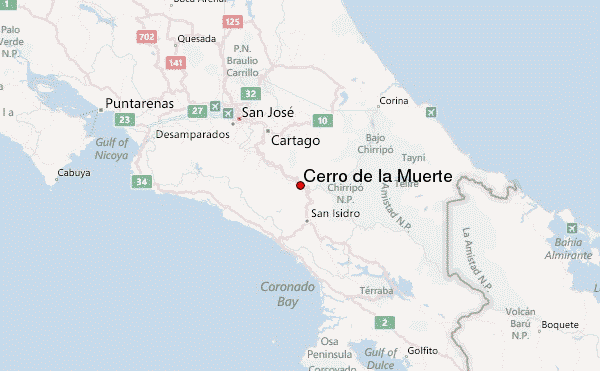
Cerro de la Muerte, Sea Turtles, and Carara National Park

We left Corcovado early on Sunday morning. We packed, ate breakfast, and piled into three boats and headed back down the river towards Sierpe, where we got back on the bus. We stopped at a little grocery store and were allowed to pick out a snack and drink since it was going to be a while before we stopped for lunch (Pringles and Apple Juice). We then got back on the bus and headed out to Cerro de la Muerte. This is a higher elevation ecosystem and is the second highest elevation in the country. 

Cerro de la Muerte, where we stopped on our way to Santa Rosa from Corcovado.
We stopped at a restaurant for lunch which was walking distance from the trail we hiked on. This restaurant had hummingbird feeders which was really cool because we could watch the hummingbirds while eating lunch. They were so little and cute! 

We then walked up the mountain and did some species reports on mostly plants and a salamander. It was pretty cold and rainy as we walked up the trail - I could feel it in my lungs as we hiked further up. The vegetation at this elevation was much different from that of Corcovado. The plants have to deal with more rain and stronger winds. We did all of the species reports back in the restaurant because it was too cold and wet to do them outside. We eventually left and drove for a while on the bus. We stopped at a restaurant on the beach and were able to catch the sunset. It was so pretty - by far the best one yet. 

Sunset on the beach
We then had dinner, which was really good (I ordered nachos) - the restaurant was right off of the beach where we saw the sunset. After dinner, we drove for another hour or so and finally made it to our hotel, La Pelicana, which was also on the beach. It was a super nice hotel! I spent the night playing cards with some of the other students, and then I finally went back to the room and took a nice hot shower... first time since I left home! 

The following morning I think could be considered the best Monday morning I have ever had. I woke up early to pack up my stuff, and then I went outside to write in my journal. There were a few of us sitting out there, and one of the girls came running from the beach saying she found baby sea turtles! We all ran out to the beach and found maybe 4 or 5 baby turtles crawling towards the ocean! It was one of the best experiences I've ever had. I watched them for over 30 minutes. We also found the nest and saw two other babies emerge from the sand. It was absolutely unbelievable.

Photo creds to Daniel
After that excitement, we ate breakfast and got back on the bus to go to Carara National Park. Here we did a lot of species reports on plants and a few animals, including a ghost bat! 

This is the ghost bat! (photo creds to Google)
Carara National Park
We then traveled from Carara to a nearby beach, where Alan and Kathy ordered us Pizza Hut for lunch! It was sooooo good - kinda a nice treat after a lot of travel days. There was a stray dog who looked like a dalmatian mutt that sat with us during lunch. He was so sweet, and we fed him a lot of our pizza crusts. Kathy also had set up a little salad for all of us, which was really yummy!