Wednesday, April 22, 2015

Parismina

So after we left Tirimbina, we drove to a place called Parismina. This is a small town located on the Atlantic coast of Costa Rica. It was a fairly long afternoon of traveling (remember we didn't leave Tirimbina until late morning). We drove through some pretty areas, as well as others dominated by banana plantations. They were everywhere - Chiquita and Del Monte, primarily. We would be driving down a road for easily 10 minutes without seeing anything but banana trees.

The Chiquita banana plantation we passed on our way to Parismina. Soil erosion, massive chemical inputs, and human health risks are all environmental problems associated with large-scale banana production. 

Each banana tree had a plastic blue bag over the fruit, which prevents flies from laying eggs in the fruit and thus creating the perfect bananas that every American desires, of course with a few strings attached. Those bags contain many pesticides to prevent bugs from attacking the fruit. They are also used just once and then thrown away, creating a tremendous amount of waste. Each of the two plantations we passed contained massive water-tower-looking tanks that actually contained all of the pesticides and herbicides that will be used on the plants. It was amazing how large those tanks were... 

After a few hours driving through nothing but banana plantations, we finally made it to Parismina, or at least to the dock where we would load into boats that would take us to our hotel in Parismina. Basically, the area we were staying in was an island (man-made), which was one of the results after the creation of a small canalish-thing. 


It was a short boat ride to where we were staying (I wish I could remember the name of the place). It was super cute (and had a pool!). We stayed here for only 2 days, but those were some pretty amazing days (well, nights actually). 

View of the hammocks and gardens from the dining pavillion

The cabins we stayed in

From the boat (canal view)
We arrived in the afternoon to Parismina, and had most of the afternoon before dinner to settle in (for most that meant taking a dip in the pool). After dinner, we had a lecture on sea turtles! After lecture, probably around 8:30 or so, we piled back into the boats and took the short boat ride across the river to Parismina (the town). We were greeted by three members of the local Turtle Rescue group, who were going to take us on a typical night patrol along the beaches of Parismina. We were split into three groups (one per guide) and took our separate paths down the beach. Unfortunately after 3 or so hours of walking, we didn't spot any turtles (which was okay - we already planned on coming back the following night). 

So the next day, we left in the morning after breakfast to go on a boat ride on the canal, mostly doing bird watching. We saw some pretty amazing birds, along with some White-Faced Capuchins and lizards. 

Egret
Riding through the canal in Parismina (Atlantic Coast)
We spent all morning out on the water and returned to the hotel for lunch. Later that afternoon, one of the turtle patrollers, Jerry, came and gave us a talk about sea turtle conservation, particularly in Parismina. He and a few of his friends started the program nearly 15 years ago. He explained how Parismina (where he grew up) was primarily a turtle eating town. Starting a turtle conservation project did not initially go over well with many of the residents in the town, but they continued anyway. Every night they would go out and patrol the beaches. Eventually, they got a website set up and were able to start recruiting volunteers to help  protect the sea turtles. Each volunteer pays $27.00 per day ($17 goes towards their homestay family and the other $10 goes towards paying patrollers at night). In total, this conservation project releases 10,000 baby turtles a year. Sadly, only 1 in a 1,000 of these babies will survive to adulthood. Most threats to sea turtles are human-caused, such as climate change, beach erosion, bleaching corals, destruction of nesting sites, light pollution, hunting, and fishing. Plastics are also an important factor, as the turtles can mistake them for jellyfish (their main diet).

Jerry talked for a while about the importance of conserving not only sea turtles, but wildlife in general. One thing he said really stuck with me, which was that one of the biggest ways people can help is to reduce, REFUSE, and recycle. Refuse to purchase harmful plastics, refuse to participate in the industries that cause the most harm to wildlife. It was a very interesting, and rather brilliant, twist on the famous saying. Anyways, after the lecture, Jerry took us over to the beaches by Parismina to show us the hatchery they are building. It is a 3m x 15m area of sand to put clutches of turtle eggs in. To "build" the hatchery, they have to sift through all of the sand in that area to remove branches, plastics, and bad sand - a process that can take many weeks to complete.

Jerry talking about the hatchery

Hatchery in progress
After looking at the hatchery, we went to a local craft fair in Parismina. This fair has jewelry and other crafts made by people in Parismina. 90% of the profits from this craft fair went to the locals, with the other 10% going to help protect the sea turtles. It was an amazing experience, as we not only got to interact with more locals, but a portion of the money was going to such a great cause!

We got back to the hotel later that afternoon, and after dinner we were on-call for turtle-watching. We went later in the night to look for turtles (I think we left closer to 10:15). We split into three groups again, and split up down the beach. Not 20 minutes later, we got flashlight signals from the group ahead of us that they found a turtle! We power-walked down the beach and got to the site of the turtle. At first, it was so dark that I couldn't even make out the shape of the turtle. But when Jerry took out his flashlight, I saw the most beautiful, gigantic sea turtle (about 1.8 m long).

This isn't anyone from our group (creds to Google), but just so you can get an idea of the size of these turtles. We weren't allowed to bring cameras because it was a) too dark and b) flash would affect the turtles
By the time we reached this turtle, she had already finished laying her eggs and had begun to bury them in the sand. Her flippers are huge and incredibly strong and powerful, and we watched her move the sand and make her way back to the ocean. While she was heading back to the water, the patrollers and volunteers started the task of digging up her eggs from the nest. They do this with every nest they can find in order to prevent poachers from finding them from the turtle tracks. They have very little time from when the eggs are layed to move them, as doing this too late could kill the babies inside. 

After we watched her go back into the ocean, we split back into our groups and started heading back towards the entrance to the beach. My group was the first to leave, and we ended up finding a second turtle! This one luckily had just gotten to the beach, and we got to watch the entire process. We watched her dig the hole with her back flippers, as well as lay the eggs! It was an unforgettable experience! 

Leatherback Sea Turtle
(Photo credit to Google)


Friday, April 3, 2015

From Pocosol to Tirimbina (with La Selva in between)

After our lovely stay Eladio's, it was hard to say goodbye but we had to venture onwards to a station called Pocosol (yes, that means little sun). We left Eladio's promptly 15 minutes late (we're on Tico time down here), so 8:15 it was. It was another 15-16 km hike out of Eladio's to our next destination of Pocosol. This hike I thought was a tad bit harder than the first part, mostly because it was ALL UP HILL. So yeah that was a fun hike. Still one of the most beautiful places I've ever been - the Children's Eternal Rainforest definitely did not disappoint. It was absolutely stunning. 

So with this second hike, we had the added task of having to cross a river. And this wasn't like any old stream we had been crossing on previous hikes. This was a real river. The rangers, Moncho, and Johel used a bamboo tree as a barricade to prevent the rest of us from getting swept downstream. It was actually really fun to cross it, though it was a bit deep...

About to get really wet...
(Photo creds to Carson)
Once we all crossed the river, we were able to continue along at our own pace until we hit the top of the tallest hill for lunch at around 12. After lunch, we all continued on to Pocosol, which was a really cool place tucked away at the other end of the Children's Eternal Rainforest.

The building where we all slept - my room was the bottom right
View from the balcony of the main building
We only spent 2 nights in Pocosol, mostly doing bird diversity. The first morning after our arrival, we went bird watching at 6am and saw some really cool birds! My favorite is still the Oropendolas, which nested in one of the trees right outside the main building.

Chestnut-headed Oropendola
You can see their nests hanging from the tips of branches around the birds
That day we spend doing other species reports around Pocosol, and then that afternoon we were given a lot of free time, so I went with many others to a waterfall that was maybe a 30-45 minute hike down some trails. It was really pretty: 

Waterfall, Pocosol
Then later that afternoon we did some more lectures and did species reports on many birds, such as the Black-mandibled Toucan, the Great Kiskadee, the Clay Colored Thrush (national bird of Costa Rica), and others. After dinner, we had a statistics lecture to introduce us to some tests we may use for our independent projects.

The following morning we left Pocosol. A truck came to collect all of our equipment and bags, and then an ex-military truck came to pick us up and bring us into town to meet our bus. 

Leaving Pocosol in style!
(Photo courtesy of Susan)
Once we were all boarded on our bus, we headed out to La Selva Biological Station (yes, THE La Selva). So for those of you who don't know about La Selva, it's located in Braulio Carrillo National Park. According to their website, La Selva is, "recognized internationally as one of the premier sites in the world for ongoing research in lowland rain forests." So basically it's a big deal. Basically envision dropping a really small university in the middle of a rain forest, and you have La Selva. It was weird, and none of us were really a fan. All of the paths throughout the park were paved, which is just odd and seems really unnatural. But the rangers were all super nice and gave us a tour of the trails after we arrived. Our group saw some cool bugs and birds:


Sleeping Peccari
Baby Fer de Lance (very poisonous snake)
Black-Mandibled Toucan
Snowy Cotinga

Upon arrival in La Selva also meant laundry for the first time in nearly a week (we had been wearing the same 2 pairs of clothes for that entire time). Laundry was welcomed with open arms, along with clean clothes brought by Kathy when she met us at the bus after Pocosol. 

The only lecture we had in La Selva was on Tree Fall Gaps, so we all hiked out to a gap in the park and sat on the trail while Alan lectured. We then did a small activity showing how different species of trees can grow in the gap, and how it can be decided randomly. We did this by dividing into 3 groups (representing a species of tree), all determined by the type of party hat we were wearing. I was in the princess group, and there was also the Elmo group as well as the High School Musical group. The way the game worked was Moncho would draw one of our names from a hat, and that meant that we as an individual died and we left a gap in the canopy. Then Moncho would pick a second name, and whatever species that person was, was the species that would regrow in that gap (so the first person would change party hats). It was a really interesting way of showing how in many cases, a tree fall gap is filled randomly.

We spent only 1 night in La Selva, but it was a very cool experience to see where many famous experiments have been done in the tropics.

After La Selva, we took another road trip to a place called Tirimbina, which is located a little further North of La Selva. We stayed here for 3 days. This place was adorable, and the place we stayed was located at the opposite end of the main part of the reserve.

View from our room
Humans in the Tropics - Forestry

The first of the three days spent in Tirimbina was a Humans in the Tropics day. That day focused on forestry, and we learned about many different stages and types of forestry. The night before we had a lecture as an introduction, so here is a brief summary of what I learned:

- Earth loses 20,000 Ha of forest per day
- Major drivers of deforestation include: agriculture, wood, infrastructure expansion (mostly roads)
- Some other factors: economic, institutional, technological, cultural, demographical
- The Amazon Basin is nearly 20% deforested / already, mostly because the construction of roads leads to more roads and so on
- Overall, deforestation has slowed down in Brazil, but other countries such as Peru, Bolivia, Guyana, and Colombia still have significant deforesting of the Amazon
- 89,000 acres of rainforest were logged to complete New York City's boardwalk, as an example
- On average, we lose 380 species per day

So we went on a field trip to look at different types of forestry. Our first stop was a nursery. This nursery promotes plantations in the area. It's owned by families and produces 400,000 - 500,000 plants per year, 40% of which are for production. Many of the native species grown here are for reforestation, as well. Clients are usually landowners who buy around 8,000 plants. This nursery also gives away many plants for protection purposes. They grow 40 different species there, and the most abundant species varies per year. The native species stay around 4-6 months while exotic species stay anywhere from 2-7 months.

So after the nursery, we went to a couple different types of plantations: one was solely exotic species while the second was all native species of trees. There was a very clear difference, as the native species plantation looked "more" like a forest than the exotic plantation. There were epiphytes growing on the trees and more life in terms of bird species and animals in general.

After lunch, we stopped at a farm which has an intact forest on the property. There we learned about Reduced Impact Logging. This process is basically when a landowner can go through this long process of having certain sized trees removed from their property every 15 years of so, done so in a much more sustainable way with minimal damage to the environment.

So that night after dinner, we watched a documentary called Raids in the Rainforest. It talked about illegal deforestation in a national park of the Amazon in Brazil. Specifically, it talked about how one woman, with the help of her team, go about protecting the Amazon from deforestation. I would highly recommend watching this film, as it very clearly illustrates the daily problems conservationists face.

We had a discussion afterwards about the documentary, and I'm not going to lie, it was a tough one. We were all in a state of disappointment and there was a mutual feeling of hopelessness in the air. It's so hard to be so passionate about saving the environment when there seems to be little hope in saving it because a vast majority of people don't care. The solution is not simple by any stretch of the imagination. There are so many factors that go hand in hand with deforestation - economic, education, social. It was made clear in this film that poverty does not excuse people from their crimes. We don't excuse people from robbing a store because they are poor, so we can't excuse them from cutting down trees to make money, either. But the other layer to this problem is that many of these poor people are hired by wealthy people who hide behind the laborers of their small industry. Those are the people who need to be caught, not those who do the dirty work, as they are easily replaceable for those wealthy people.

Alan brought up a really interesting point that I want to highlight for all of you reading this:

Costa Rica and the United States both had to lose over 80% of their land for the general public to realize it needed to stop. Do we wait for over 80% of the Amazon to be destroyed before people realize we need to stop, or do we learn from our mistakes and change our ways before it's too late?

Some other ideas brought up during the discussion:
- Offer incentives to people to not cut down the trees
- Don't even bother with "sustainable" timber farming - pay people the $300 to stop cutting down trees (that's the amount people usually make with Reduced Impact Logging, on average)
- Put international pressure on Brazil and other South American countries to stop deforesting the Amazon

So think more about deforestation and speak out about making a change. Because if we lose all of our tropical forests, then we will have a lot more problems on our hands...


Back to Tirimbina

So on a more positive note, the rest of our time in Tirimbina was incredible. We went on a decently long hike from our station to the main part of the reserve, which took us 4 hours because we stopped to do species reports along the way. Towards the end of the hike, we had to cross a super long bridge and it was soooo cool!

It was a suspension bridge that extended over a river and through part of the canopy and ended at the main part of the reserve
(Photo courtesy of Dan L.)

So after lunch at the restaurant in the reserve, we had a quick lecture and then had the option to go swimming in the river (which was about a 30 minute hike). That was a lot of fun, and we stayed for an hour or so until returning to the reserve. We took three vans back to the station where we were staying, and then after dinner we had a lecture on bats from Richard Leval. 

The following morning was our last in Tirimbina, and they gave us the morning off before we left at around 10:30 to explore. So I went on a walk with Vian down the road to the farms. On our walk, we ran into some chickens and their chicks, and we played with them for a bit and they were just so cute!

Momma made sure we didn't get tooo close
Just look at that little face!


Tuesday, March 31, 2015

Eladio's

Our second field trip definitely did not disappoint. On Friday the 13th, we loaded up three small vans and headed out for a short ride to the entrance of the Monteverde Cloud Forest Reserve. This second two-week field trip began with a hike through the Monteverde Cloud Forest and then through the Children's Eternal Rainforest, ultimately ending at a shelter named after the original owner - Eladio (but more about that later). We started this trip with just one week's worth of belongings, which for me included (for the most part - left some stuff out): 2 shirts, 3 pairs of shorts, hiking boots, flip flops, water shoes, a bug net, sleeping bag, raincoat, a very long reading book, deck of cards, water bottle, and 3 pairs of socks. What more does one really need in a single week?

The hike commenced at around 9:15 or so in the morning, and took until about mid-afternoon to reach Eladio's. We walked through the Monteverde Cloud Forest Reserve for a while until we crossed into the Children's Eternal Rainforest, where we would continue on for many kilometers (I want to say the whole hike was 15k) to reach Eladio's. But we all met up a shelter approximately halfway through the hike to stop for lunch and enjoy some time in the sun and river. Everyone took off after lunch in groups, and we continued onwards towards our destination - Eladio's. I walked with a small group at the end of the pack - slow and steady wins the race, right? It was nice to enjoy each other's company and take in the absolutely stunning rainforest we were walking through. We got pretty close to the shelter when we actually passed the two rangers with the horses who carried our food for the 4 days we would be at Eladio's (that's right - all of our food had to be brought there ahead of time because Eladio's is the definition of the middle of nowhere). We had been warned about the horses before the hike - one was rather cranky and quite appropriately named Luis Suarez after the infamous biting football player from Uruguay. Clever, right!? 

THEY WERE SO CUTE
(Photo creds to Dan L. - I was a bit too excited to take a picture)
After the quick, much-needed pony break, we finished our trek to Eladio's and finally arrived at around four in the afternoon. We got settled in our two rooms (or some on the porch). Our room was rightfully named "Stank Pit" - because my gosh the smells coming from our clothes and shoes and everything were awful. And it remained that way for the entirety of our 4-night stay. The end of day 1 culminated with a 7:30 bedtime for many - well-deserved I think!

Our first full day at Eladio's mostly consisted of orientation hikes through the trails around the shelter. We did numerous species reports and crossed a small river or two along the way. We got back to the shelter at around 11 or so, and had free time until 1, which was when we continued out for another short hike and did more species reports. We got back not an hour later, and I decided to spend my free time that afternoon before dinner reading by the river. 

(Photo creds to the wonderful Lidia)

After dinner, Eladio told us the story about the history of the property, which I shall share with all of you (It's a fairly long story, so bear with me): 

So in 1962, Eladio came to Monteverde for the first time. He lived on his father's land. All of the valley was primary forest when they arrived, and it all belonged to the government of Costa Rica. The government gave away land to people if they worked it. At first, they only had a small trail to their property, which they used initially to carry grass (for the cattle to graze on) and banana shoots (to start a plantation). Eventually, he made the trail wider so he could bring cattle to his property. At some point, he sold his father's land. 

In 1969, a Canadian mining company came into the area looking for sulfur, and was giving away jobs along with land. This company left in the early '70s because the Costa Rican government was selling the profitable land for more than the company was willing to spend. Of the land the mining company had, 70% had been logged. One miner sold 300 Ha to a quaker named Wilford (who Eladio worked for at the time). Eladio was given 50 Ha of that land. 

So now Eladio had land once again. He was hired by many of his neighbors, as well as Wilford, to cut down trees on their properties. In 1972, the Tropical Science Center (TSC) took control of the land (now it's called the Monteverde Cloud Forest Reserve). Eladio began working for the TSC as a park ranger and started to learn a lot about conservation of land. 

In 1975, the government declared the area around the Peñas Blancas river valley a protected area (for the watershed). The government then decided not to because it was too expensive to do so. If they had done so, they would have had to buy the land off of the people who lived in that area in order to keep it a protected area. The community actually wanted the government to buy the land. Now around this time (1985), Eladio lived on his farm with his wife. 

At one point, the park decided to send tourists to live with Eladio, along with biologists and photographers. Eladio sold his land to the biologists, who wanted to put the land aside for conservation. The Monteverde Conservation League collected money to buy land through donations to give to the TSC. Eladio's was the first property purchased. They eventually made enough money to buy 10,000 Ha of land, but they couldn't decide who should own the land. The Monteverde League only purchased the land, they wanted nothing to do with running it. So this resulted in a long battle between the Monteverde League and the TSC over who should run the land. 

Shifting gears a little bit. Some elementary school children from Sweden came to Monteverde and saw the rainforests here and decided they wanted to help raise money to buy the land. They returned to Sweden and were able to raise enough money to purchase the land (the money they raised was matched by the Swedish government). So hence, now it is called the Children's Eternal Rainforest. This is now the largest private reserve in Central America, covering 55,000 Ha of protected area in total. There is an estimated 70,000 Ha of protected area in total, which includes the land hotels use as part of their tourist attractions in the area. 

So now back to Eladio's. Randomly, an entomologist from the United States was hiking through the rainforest and got lost coming from Pocosol, and ended up at Eladio's. This guy loved it so much, that he brought a group of his students (from some university on the West Coast) back to Eladio's. He showed up with 18 students, who camped outside in tents. Ever since then (1986), he brought students every year to Eladio's as a learning experience. In 1991, he came with a group from EAP (I don't remember what that stands for), and now Eladio's is exclusively for students and researchers. 

Now that the area is all protected land, the forest has begun to regrow, which in turn means that animals have started coming back (including jaguars and pumas). 


So Eladio is a pretty cool guy, with a pretty amazing life story and impact on the environment (both good and bad). He was also super sweet!

So the following day was when El Terimoto arrived to our group. And by that, we mean the stomach bug. I was one of the first victims, along with a few others who spent the day sleeping and making trips to the bathroom / forest. And since that day, El Terimoto took another victim or two every day for over a week (we are even convinced that it evolved into other sicknesses later on). Luckily, Eladio had some plants that grew around the shelter that help with upset stomachs, and he used it to make a tea for those of us who got sick. Unluckily, the tea was the worst thing I have ever tasted. Ever. Think of the smell of the most generic plant (not flowers, just the plant part). Do you have that image? Now imagine drinking that. Pretty nasty. Don't get me wrong, it worked really well, if you could drink the whole cup!

That night I was feeling well enough to go on a night hike to look for frogs and other cool swampy organisms. And this night hike very quickly turned into a mud-bath for almost everyone. We walked through parts that had waist-deep mud. We had a few unfortunate souls who got stuck in the mud (even losing some shoes in the process). But it was all worth it, as we saw so many cool animals, including a RED EYED TREE FROG!

RED EYED TREE FROG
(Photo creds to Shane)
The following day was our last day at Eladio's. It was the first time we had experienced a full day of rain our entire time in Costa Rica thus far, so needless to say we didn't quite know what to do with ourselves. We spent the morning going over our independent research project ideas and their feasibility. That took numerous hours but was rewarded with numerous hours of free time, which was spent playing Uker, reading, and just hanging out. We also started our third and final field project. This time, the entire group "collected" data and we would individually write a paper on it. Our TA's (Moncho and Raquel) went out while we had free time and collected leaves of three types of palms (Geonoma, Calypterogyne, and Chamaedorea). Each had a different leaf morphology, and we had to count the number of epiphylls on 12cm x 12cm grid per leaf, on both old and young leaves. We did that on and off all afternoon as Moncho and Raquel returned periodically with more leaves. 

So even though much of my time at Eladio's was spent sick, it was still an unbelievable place that I would HIGHLY recommend visiting if you ever get the chance. Eladio is an amazing man with so many stories to tell (like the time he got bit by a Fer de Lance). 

Monday, March 30, 2015

Livestock Production


Sorry this post is a few weeks in the making - we just got back from our second field trip, this time to the Atlantic coast of Costa Rica and even into Panama. I'll hopefully be posting about it soon!

So the Wednesday before we left for the field trip was our last Humans in the Tropics lecture / field trip for our time in Monteverde. We spent it learning about livestock and meat consumption. We learned about the history of livestock here in Monteverde and its impact on the people and the economy. In the northern province of Guanacaste, land was primarily converted from rainforest to agricultural and grazing lands for cattle. In other parts of Central and South America, rainforest was also being drastically transformed into land for cattle. Why? Our fetish with hamburgers. In 1995, Brazil exported over $500 million worth of beef. In 2003? $1.5 billion. Our desire to consume beef has been exponentially growing in the past few decades, with no sign of slowing down. With this increase in beef consumption comes a drastic increase in deforestation of tropical rainforest in Central and South America.

Some surprising numbers I learned from lecture that day:

- Of the 7 billion people living on Earth, 2/3 are vegetarian.

- That only 1/3 of the human population have diets primarily focused on meat. The majority of this population lives in developed nations. As more and more countries become developed, that 1/3 could easily turn into 2/3, or higher. This increase in demand must mean an increase in supply. How do we increase supply? By cutting down rainforest to make land for livestock.

Some other startling information we learned was the health of livestock. In the United States, 70% of antibiotics used each year are given to livestock.

Yes, you read that right. Livestock are getting the majority of produced antibiotics made in our country every year. They are used to treat diseases, which really is extremely important and should be continued. The prevention of disease is just as important, though I would argue that the amount used for this purpose could be greatly reduced. The worst use of antibiotics is for growth promotion. Many medications are given to livestock and poultry simply to increase their size and shape, which would increase the meat from each animal in a quicker period of time.

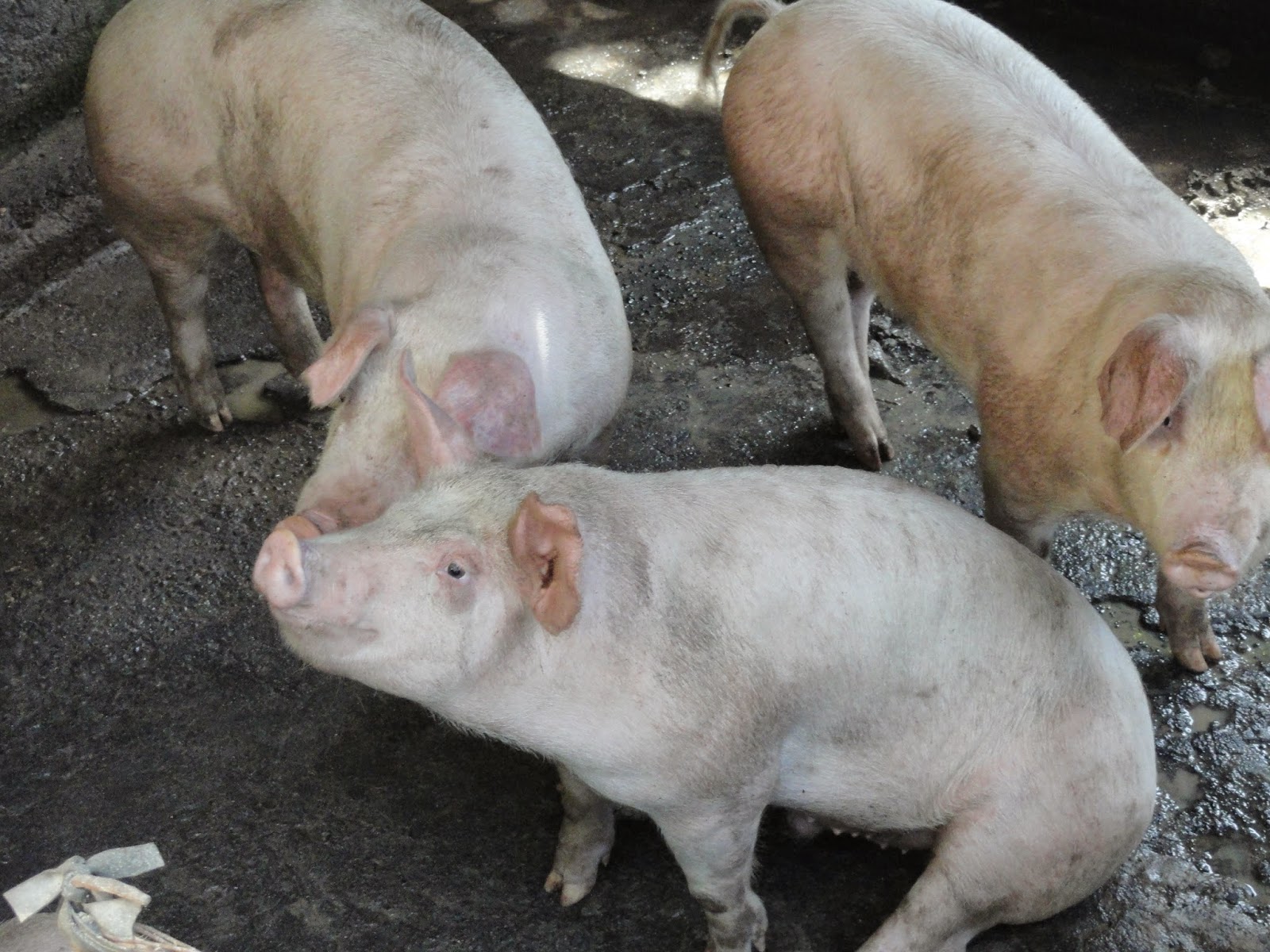
Anyway, we traveled to two farms that day. The first was owned by an elderly man named Don Jesus. Don Jesus owns and runs a small-scale dairy farm here in Monteverde. He primarily uses the milk to make cheese or to directly sell to consumers at local markets. He owns 11 cows, 8 of which give milk. He also raises pigs as a way of making some electricity and getting rid of some food scraps (I'll explain more about the electricity part later).

Three pigs that Don Jesus has raised.
Chickens on Don Jesus's farm
Don Jesus owns and runs the farm on his own, with some help from his adorable wife.

I was asking Don Jesus's wife about her chickens.
Also, photo courtesy of Dan L.
He does all of the milking for each of the 8 cows twice a day. He allowed us to help him with the milking (we did it by hand, he actually uses a machine). It was rather fun to learn how to milk a cow  - I was pretty good at it too! He had a calf tied up nearby, who I played with while everyone else was taking turns milking the cows.

He really loved getting his face scratched. 
He even smiled. 
Don Jesus also showed us his biodigester, which is a system that converts pig manure into usable energy. I won't get into the nitty-gritty science, but it's basically a long tube that holds the pig (or other animal's) manure and turns it into methane gas, which can be used to power whatever the farmer needs on the farm or his house. 

We stayed for lunch at this farm and left after a few hours to go look at another farm, one that is not nearly as environmentally friendly as that of Don Jesus's, and was also one not nearly as conscious towards animal welfare. It was a pig farm owned by a man who runs a butcher shop. He controls every part of the business, including the breeding of the pigs, the raising of piglets, and the slaughtering of the animals for his butcher shop. I have no pictures to share, as this particular farm made me sick to my stomach. I was able to stay behind with the man's horse instead of getting a full tour of his property, who was tied up to a fence post. It helped and he was really sweet. I brought him some grass from a nearby field, and that made him perk up. There was also a dog tied up nearby, and I gave her all of my water. 


It was just a horrible place, I can't even describe the noises of the pigs. I think what hit me the hardest about that day was how poor the living conditions were for the animals: pigs, horse, and dogs. The pigs were stuffed in pens, sometimes 6 or more in a space less than the square footage of your small bathroom. Nails sticking out, no room to roam, nowhere separate to go to the bathroom. The horse was tied up so tightly to a post, out in the boiling sun, with no water. He had so many ticks and was really thin. I found out later that this man bought the horse from a neighbor to use as meat for his butcher shop, which didn't help my impression of him at all.

Friday, March 6, 2015

Coffee Farming and Monocrops


So Wednesday (February 25th) was Humans in the Tropics day. We had a brief lecture at 8am on coffee production (and some other major crops also). After the brief lecture, we packed into 3 buses and went for a little field trip across town. It was such a great field trip - we went to a local coffee farm that is 100% organic, all-natural, and pesticide free. The place is owned and run by a really cute woman. Her name is Hermida, and she was definitely the cutest woman ever. She does everything herself with the help of one full-time employee and a few of her sons.

All-natural, organic, pesticide-free coffee farm
She's had the farm for nearly 30 years now, and it sits on a 2 Ha plot of land, along with 4 Ha her son owns next door. She has two rivers that run through the farm, and she has kept the forests intact around the rivers to preserve the watershed. Not only does she plant coffee, but also medicinal plants, some used for bug repellent, others to prevent erosion and for making her own pesticides and fertilizers. Many of her practices are traditional, one of which is using the moon when planting. She plants during the waning moon (gets better results), plants grow faster in crescent moons, etc. It was really interesting to see how every little thing she does on that farm has a purpose.

She grows bananas because she uses the massive banana leaves to shield her young coffee plants from the sun. In modern coffee farms, they use plastic bags filled with chemicals to achieve the same thing. Hermida then uses the leaves as a part of her all-natural fertilizer. 
We spent most of the morning walking through her gardens, learning about all of the plants she grows and what she uses them for. She was really a prime example of how sustainable farming is possible, and it can be very beneficial for not only the farmer and the consumer, but for the environment. We also talked about how Doña Hermida does not associate with a co-op. This allows her to sell her products directly to consumers, so she has taken out the middleman in coffee production and is able to make a larger profit.

Coffee beans still on the plant. The redder the beans, the higher-quality the coffee.
Towards the end of the morning, she brought us to her drying house, where she keeps all of her coffee beans drying in the sun. There were so many types of coffee, and if I had any knowledge of coffee-lingo I would tell you what they were...

The greenhouse where she keeps all of her drying coffee beans

We stayed at her farm for lunch, which consisted of primarily fruits and vegetables grown in her garden. It was absolutely delicious! After lunch, she let us help her hand-grind coffee beans to make hot coffee, which was really fun! 

You put the coffee beans into the hole at the top and grind it into ground coffee
After we took turns grinding up the coffee beans, she brought out her coffee maker and a pot of hot water. We could finally see this whole process coming full-circle, from the coffee plant to the de-shelling process to drying the beans to grinding them into a powder and finally making coffee. It was such a long process, and it's incredible that she does this whole thing by herself.

The best kind of coffee maker (and environmentally friendly too!) You pour the coffee powder into the bag at the top and just add hot water! 
Learning about coffee production was definitely an eye-opening experience. We had a few lectures on sustainable farming and the effects of monocropping on the environment. So unfortunately, the rest of this post isn't quite as positive as the first, but I think it's really important for people to know about because this type of farming is what we're supporting when we buy fruits and vegetables from the supermarkets in the U.S. I'm going to talk about not just coffee, but some other major monocrops that are produced not just here in Costa Rica, but in other parts of Central and South America as well as in Africa.

Coffee

Coffee is very important to the Costa Rican economy. It encouraged the creation of a strong middle class, and in the early stages of coffee here, the government gave away land and coffee plants to people, then bought the coffee off of those farmers for export (basically, there was no way you could lose, unless you really sucked at farming). This caused a huge influx of immigrants from Europe who wanted a part of this fantastic deal. Here in Costa Rica, farmers focused on high quality over high quantity coffee. Now, there are 7.9 million tons of coffee produced annually, but that doesn't even compare to the coffee productions of Brazil, Vietnam, and Colombia. All of the processing of coffee is done in the country of origin, and each phase of production has different impacts on the environment. 

So now a little bit about the coffee plant... Coffee is actually an understory plant. It originally grew in rainforests and was shaded by the numerous layers of canopy above. But in terms of growing coffee for production, plantations don't always for the most environmentally friendly option, as shown below: 

http://www.coffeehabitat.com/wp-content/uploads/2006/02/shadelayers1.jpg
"Rustic growth" is not super common anymore, but essentially it is when coffee is still being grown in the rainforest, with numerous layers of canopy above it. "Traditional polyculture" reduces the amount of canopy, and so on until you get to "shade monoculture" and "Sun coffee." These last two are the most commonly used today. Sun coffee is probably the worst, as (1) the coffee is not being shaded and has a higher risk of being affected by a fungus that can ruin an entire crop of coffee and (2) this also contributes the most to erosion, as there are no other plants around with larger roots to hold the soil together, or even to just add nutrients. "Shade monoculture" is a close second to sun coffee. This is slightly better, as there are trees planted between the rows of coffee, which not only adds nutrients to the soil, but can also help prevent erosion. 

There are numerous negative environmental impacts of coffee, including deforestation, sedimentation, erosion, and run-off of pesticides into local waterways. In large coffee plantations, there are numerous chemical inputs which contribute to the run-off. There are huge amounts of biodiversity loss, which for a tropical environment with a lot of biodiversity, it can be devastating. Unfortunately, this is also an unstable business. Coffee is a seasonal crop, so there are many social problems associated with coffee plantations (people are often out of work for months at a time). 

And that was just coffee. 

Bananas

The story of bananas is a little different from that of coffee. Once upon a time, there was a United States-based company called United Fruit (currently known as Chiquita). They came into many Central American countries and basically took over the banana industry. At first it was very helpful. Because bananas were grown in the middle of Costa Rica, they put in a lot of time and money into building railroads and roads for transportation. Many think that without United Fruit, railroads may not have made it to the country for a very long time because of the high cost. This company had a lot of power in the government, as they controlled much of the economy of not just Costa Rica, but Guatemala, Nicaragua, and numerous other countries. They bribed the government and were able to bend rules to benefit their company. Today, this giant company isn't in control anymore, but Chiquita and 4 major banana companies are, and they still have a lot of influence. These companies control the prices, they control the trade, and many don't respect labor codes or workers' rights. 

So besides all of those social and economic impacts of bananas, there are numerous environmental impacts. Deforestation is a major one, along with land transformation to grow these huge banana plantations. Banana plants are pretty tall, and require a lot of upkeep. Something not many people know is that these plants only produce one bunch of bananas per plant. So after each bunch is produced, a whole plant is cut down and a new one is planted. The rest of the banana plant is waste, typically not used for livestock feed or anything, which is such a waste. There are also huge chemical inputs. They are picked green, shipped, and then when they are ready to sell, and ethylene gas is sprayed until the bananas turn yellow. Soil erosion, chemical runoff, and waste are other major environmental impacts of bananas. 

Fair-Trade

When you go to the grocery store, how often to you buy Fair Trade products, such as coffee? If and when you do, its to support the local farmers who are growing that product and directly selling to Fair Trade. The purpose of Fair Trade is to ameliorate price swings for the producer. If there is a low year for sales, the producer is guaranteed a price no matter what the sales are. It offers growers a fair price, which is the gist of Fair Trade. They are given decent labor agreements and are usually offered community and business development, such as the building of schools and scholarships for the children of farmers to go to college. Fair Trade eliminates the middleman. The growers trust the corporations to assure fair wages. In terms of what the consumer is getting out of this deal: we feel genuinely good about buying Fiar Trade coffee because we're doing good for the grower. But are we really?

There are thousands of farmers worldwide (mostly Central / South America and Africa). All of them get an "equal" share of sales profits at the end of the year. But when this is spread out over the thousands of farmers, their families, and employees, this turns into an extra $0.18 per person per day worldwide. In some places, this is a lot. But how is this helping these people? Is this even a viable option for these farmers? I don't know. They should be getting more, but how? It's all based on sales, so do we all need to up the amount of Fair Trade coffee we buy? 

So where do we go from here?

There is no easy answer to this question... We debated this for a long time, easily over an hour. These were some of the ideas that we were collectively able to agree upon: 

- There should be a fee on products that are not organic, all-natural. We should "punish," in a sense, those who do not buy organic, and that "punishment" should be paying extra for all of the chemicals they are purchasing along with the product. Reward those who buy organic with low prices, not the other way around. 
- Developed nations consume too much. We often forget that we don't actually need coffee to survive. But cutting down our consumption, we can collectively reduce the negative environmental impacts these huge plantations have. Cut back one cup a day. Or buy coffee brands that have certifications. There are dozens out there, including workers rights, less environmental impacts, all-natural, organic, etc. Buy coffee that tells you exactly where your coffee is from, who the farmer is. You'll feel better and will be doing better, too. 

The biggest message I got from that day was to just think more about where our food comes from. We have become so disconnected from the production of our food, so we don't think about the process. So think about the process, do your research, and buy smarter. 

Monday, March 2, 2015

Estación Biológica, Monteverde

This post is a week in the making, but we finally made it to Monteverde Biological Station! This place will be our home until mid-March, which means lots of lectures, Spanish classes, nature hikes, downtown adventures and much more!
So that first day we arrived (I want to say Saturday?) we just got settled into our rooms and had a small orientation lecture before dinner. The station is super nice, and it has that homey feel to it along with being a great place to learn and study.

Biological Research Station - Monteverde, Costa Rica
The classroom in the station, where we do all lectures and is a great place to study.
It's been about a week since we arrived, and we've already done so much! That Monday after we arrived, we went for an orientation hike through the forest on the mountain behind the station. It was such an awesome hike - basically this meant decreasing levels of oxygen paralleled with increasing amounts of mud. But nonetheless, it was an amazing hike. Our goal was to hike through some of the trails, reach the top of the mountain, and do some species reports at the top...

The road less traveled..?
All of the mud


That afternoon we walked to our Spanish class, which will take place at the Spanish Immersion School in Monteverde. We have class Monday, Tuesday and Thursday from 2:30 - 6:00 pm and Fridays from 2:30 - 5:00 pm (so much Spanish). Oh, also, this is what the place looks like: 

Spanish Immersion School (CPI) 
It has a hot tub, ping pong tables, workout room, yoga, cooking classes, and so much more. Its basically like going to Spanish class in a resort and spa. Anyway, the first day of class was spent taking a placement exam (written and oral), and playing some games with the professors. In total, there are 5 classes, each with no more than five students. My class has four, which is so nice. We get to talk a lot with the professor which helps improve conversational skills. I definitely wish we had classes this small back home, I would learn so much more. 

After Spanish class, we came back home (we get the option of taking a personal bus, as the walk back to the station is up a very big hill and it's dark) and had dinner. Every day after dinner is free-time, which most of this past week was spent studying the plant and animal species for the big exam on Saturday.

Tuesday was the first "official' start of classes at the station, which meant Tropical Community Ecology with Alan at 8:00 and Tropical Diversity at 11:00. Tuesday we spent in lecture for maybe an hour, and then went outside and did a lab. This lab entailed separating into groups of 2-3 and going into the woods and identifying different species of vines that can be found on the trees. After we could identify them, we were to choose 2 species from two different families, take a sample of 30 trees, and determine whether those 30 trees had one species or the other, both, or neither. Once we got back to the classroom, we performed a Chi-Squared test to compare expected values with our observed values. It was a cool little activity, and it allowed us to practice our statistics, too. 

After the activity, we went straight into Tropical Diversity at 11 until lunch. After lunch, we had a small break until Spanish class at 2:30. I learned more in that Spanish class than I did all last semester at school. Even though we were only reviewing preterite and imperfect verb tenses, it was just so much better because the professor was so much more engaging. We sang songs, talked about random things in Spanish, and just had a good time doing it. This is such an engaging Spanish class, and I'm so happy that it's an immersion school! 

After Spanish class, we got back to the station and had dinner and then most of us spent that night studying for the exam again. 

Wednesday was Humans in the Tropics day, but I'm going to talk about this in a separate post (so stay tuned)! 

Thursday was basically the same as Tuesday - we had Tropical Community Ecology in the morning at 8, but this time we learned about weather systems and how the rotation of Earth around the sun, along with its tilt, affect the weather in tropical habitats across the globe. We did a bit of a simpler lab - we separated into groups and used a globe, flashlight, and laser pointer to figure out how the seasons and all that works more in-depth. It was really interesting (and rather easy - thank you AP Environmental Science)! Tropical Diversity lecture followed at 11 again, but I can't remember what we talked about... 
At 2:30 we had Spanish again, which was just as awesome as Tuesday! We talked about prepositions a little bit, went over homework, and reviewed a little bit for the quiz on Friday. 

Friday - The schedule was a little backwards compared to Tuesday and Thursday. We had Tropical Diversity in the morning at 8:00, and promptly did a little lab outside at around 9:00. It was a really cool lab - in groups, we went out into either the forest or in the open area around the station and, from a sample of 20 trees, we recorded the number and types of lichen species found on each. It was a pretty cool little experiment, and it reminded me a lot of one I did in AP Environmental Science my senior year of high school, where in order to look at species diversity, richness, and evenness, we went out to the parking lots and counted the number of each make and model of car - they both essentially showed the same thing in terms of locations with more species richness and evenness.
We had Tropical Community Ecology after at 11, followed by lunch. Spanish was at 2:30 that afternoon as usual, and we had our first quiz of the class which luckily was super easy because I did minimal studying. Class only went until 5, which was awesome because that gave me more time that night to study for the Lab Practical exam Saturday. I spent all night studying, going over plant and animal species one last time...

Saturday - doomsday.

Just kidding it wasn't that bad. We had the lab practical exam at 9, which turned out to be slightly better than I anticipated. It was split into 3 parts: a table portion, a field portion, and a slide portion. The table portion consisted of tables covered in samples of plant and animal species (or stuffed animals). We had to answer questions about those species, which was probably the best way for me to take an exam. The field portion consisted of walking around the garden identifying species (by far the hardest portion of the exam. The slide portion was a slideshow of pictures and questions about species. I can't even explain how happy I was to finish that practical - definitely shed a few tears of joy :)

That night we "celebrated" by going into town to watch Alan's band perform at a local bar... they were pretty good :)